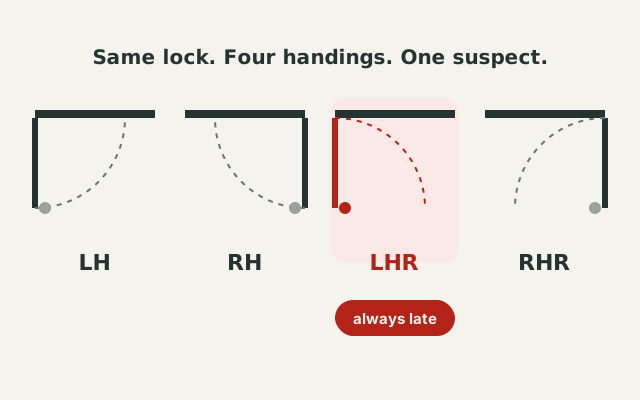
This story is a composite. The pattern is real and common; the dealer, the plant and the numbers are illustrative.
The email arrived on a Monday, which felt appropriate.
I know how this sounds. Every time we order your mortise locks for a project, the right-handed ones arrive on time and the left-handed ones are late. Not sometimes. Every time. Same lock, same finish, same order. I'm starting to think your factory doesn't like left-handed doors.
The first reaction around the table was a polite smile. A lock doesn't know which way a door swings. The factory builds one lock family on one line. The left-handed and right-handed versions differ by a handful of internal parts. There was no reason in the world for one to be slower.
But the dealer had dates. And the dates were very consistent.
Collecting evidence
So someone pulled order history for the last two quarters. The dealer was right, and not just for that dealer. Across the whole lock family, orders containing left-hand reverse locks shipped a few days later on average than orders without them. Right-hand locks were fine. Plain left-hand locks were mostly fine. Left-hand reverse was the problem.
That was interesting, because “left-hand reverse” isn't a different lock. It's the same lock, for a door that swings out instead of in.
Following the part numbers
The next stop was the 150% BOM. And there it was. Handing wasn't set by a field kit or a reversible latch. It was baked in at the factory, which meant every handing had its own latch assembly, its own trim, its own part numbers, in every finish.
Four handings times four finishes is sixteen latch assemblies where one reversible design could have done. Purchasing, sensibly, kept healthy stock of the variants that sold the most. Right-hand was the most common. Left-hand reverse was the least. Its parts were reordered in small lots, often just after the stock ran out.
Nobody in the factory disliked left-handed doors. The factory simply had sixteen times more things to keep in stock than it needed to, and the rarest of them were always the first to run dry.
The visible symptom was “left-handed doors.” The cause was where in the product the variant was created.
The fix nobody expected
The obvious fix was more stock. That would have worked, and it would have cost money forever. The better fix was to move the decision. If handing can be set at the end of assembly, or even by the installer on site, then the factory builds one lock and the handing happens last. Manufacturing people call this postponement: create the variant as late as possible, so everything before that point can be shared.
Sixteen latch assemblies become four, or one. Stock gets simpler. The rare variant stops being rare, because it's the same part as the common one.
What this taught me about variants
Every option has a location in the product, not just a value. Handing created at the factory multiplies part numbers. Handing created in the field multiplies nothing. Same choice for the customer, completely different cost for everyone else.
When I look at a configurator now, I don't only ask “what can the customer choose?” I ask “where does this choice turn into a different part?” The earlier the answer, the more expensive the option, and the more likely it is to show up one day as a strange complaint about doors.
You can see handing at work in the Rules Lab. In that model, at least, the left-handed lock is never late.