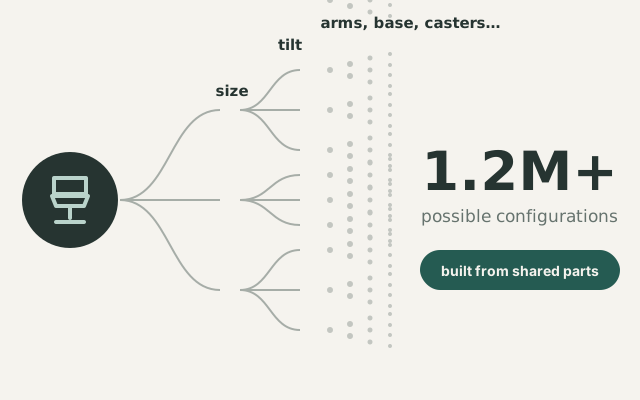
Here is a number I like to drop into conversations: the Herman Miller Aeron, the mesh office chair that has been in the Museum of Modern Art's collection since 1994, has more than 1.2 million possible configurations. That figure comes from Infor's case study on Herman Miller, the software vendor behind its configurator.
People usually react in one of two ways. Some assume it's marketing. The rest look slightly ill.
Let's make it worse
Imagine a factory that builds one of every possible Aeron, no repeats, at 100 chairs a day. It would need about 12,000 days of nonstop building. If it started this morning, it would finish sometime around 2059, by which point half the options would have been retired and the other half replaced.
Now imagine stocking them. Imagine giving each one its own part number, its own drawing, its own price. Imagine testing them. This is the moment people start looking ill.
Where a million chairs come from
Nobody sat down and designed 1.2 million chairs. Somebody designed three sizes. Then a few frame finishes, a few base finishes, a few kinds of tilt, arms that do or don't adjust, lumbar support of one kind or another, casters for carpet or hard floors. Each choice is reasonable. The trouble is that options don't add, they multiply. Six choices of four values each is already 4,096 chairs. Ten is over a million. That's combinatorial explosion, and every configurable product lives with it.
Nobody decided to offer a million chairs. It happened one reasonable meeting at a time.
So why does nobody panic?
Because nobody builds a million chairs. They build a much smaller set of shared parts, and each chair is assembled when it's ordered. That's configure to order. The million is a property of the rules, not of the warehouse.
Three ideas make it work:
- One structure, not a million. A 150% BOM holds every part any version could need, each with a condition. The order filters it down to its own parts.
- Rules, not lists. Instead of listing every valid chair, the configurator knows the handful of combinations that can't be built and blocks those.
- Prices from pieces. Nobody prices a million chairs. They price options, and the chair's price is a sum.
At Herman Miller, as part of MillerKnoll, this was my day job: writing configuration rules and BOM conditions for configure-to-order product lines across seven brands. From the inside, a big number like 1.2 million isn't scary. What's scary is one missing rule.
The question a product line manager should ask
Here's the part I find most interesting. In almost every configurable portfolio, a small share of configurations carries most of the orders. A long tail is ordered rarely, and some combinations are never ordered at all.
That isn't a problem in itself. The million costs almost nothing as long as the options are built from shared parts. The question worth asking is different: which individual options are expensive to keep, and are they earning it? A finish that adds a column to every price book, a set of rules, test configurations and stock, but sells a few units a year, is a different kind of number. That's where zombie variants live, and where SKU rationalization starts.
What the number really means
1.2 million isn't a count of chairs. It's a measure of how much choice one well-designed product family can give people without the factory noticing. The skill isn't in having a big number. It's in keeping the big number cheap.
Which is a strange thing to be proud of, but here we are.
If you want to try those decisions yourself, the Variant Portfolio Lab has a chair with 1,166,400 possible combinations, a long tail to prune and a budget to defend.