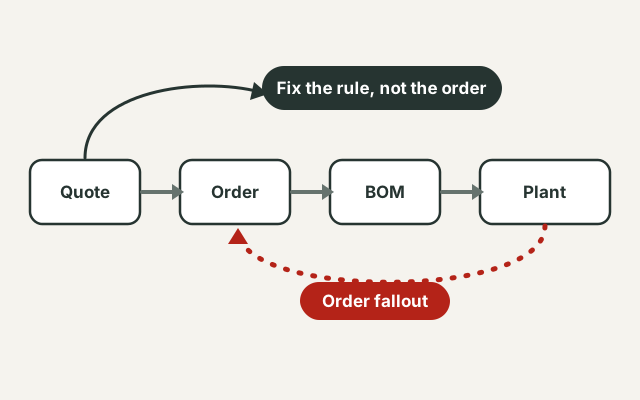
In a configure-to-order business, a perfect order flows straight through. The customer or dealer configures a product, CPQ prices it, ERP accepts it, the BOM and routing resolve, and the plant builds it. Order fallout is everything that doesn't make it through that path without a person stepping in.
At MillerKnoll I was the single-point owner of order fallout for North American B2B dealers and OEMs. Over that time we reduced quoting errors by 30%, through root-cause analysis with engineering, manufacturing and sales teams. The most useful thing the work taught me is a change of question: from "how do I fix this order?" to "what let this order through?"
Where fallout comes from
Fallout looks random when you meet it one order at a time. Grouped by cause, it is usually a handful of repeat patterns:
| Cause | What it looks like | Where the real fix lives |
|---|---|---|
| Missing rule | A combination the plant can't build was allowed | A new constraint in the configurator |
| Stale orderability | A superseded or phased-out part is still selectable | Lifecycle state and effectivity |
| Pricing gap | A valid option has no price, or the wrong one | Price build-up and dealer price files |
| Master data defect | Wrong unit, description or CMF code on a part | Master data governance |
| Timing | A change was released while the order was in flight | Change planning and cut-in dates |
Only the last column matters. Every row there is upstream of the order. Fixing the order itself treats the symptom; the next dealer will configure the same thing tomorrow.
A routine that works
- Log every fallout with a cause, not just a fix. "Corrected spindle" is a fix. "Rule missing: matte black not made for thick doors" is a cause.
- Group by cause every week. A short list of causes usually explains most of the volume. Work that list first.
- Fix it at the source. Write the missing rule, correct the lifecycle state, publish the price. Then check every channel the rule reaches: CPQ, dealer specification tools and order entry.
- Turn the failed order into a test configuration. The exact combination that fell out becomes a saved case with a known correct result, re-run before every rule release. This is how a fix stays fixed.
- Talk to the people who touch it. Engineering knows why a combination can't be built. Manufacturing knows what actually happens on the floor. Sales knows why customers keep asking for it. The best rules come out of all three.
You can see step 4 in action in the Rules Lab: each rule there has test configurations that prove it fires, and the suite runs with one click.
Why it is a product problem
A configurator is a product. Its users are dealers, sales teams and order entry; its output is orders the plant can build. Fallout is that product's defect rate. Treat it like one and the usual product habits apply: measure it, find the biggest causes, fix them, prevent regressions, and tell users what changed.
Treat it as data entry and you get a team that gets very good at fixing orders, forever. The volume never falls, because the rules that create it never change.
The goal is not to get faster at fixing fallout. The goal is to need fewer people fixing it.
What to measure
- Fallout rate: orders needing manual intervention as a share of all configured orders
- Fallout by cause, so you can see which fixes worked
- Repeat fallout: the same cause returning after it was "fixed," which usually means a missing test
- Time to resolve, because a stuck order is a stuck customer
None of this needs new software to start. A shared log with a cause column and a weekly half hour with engineering, manufacturing and sales will show you where your rules are leaking.