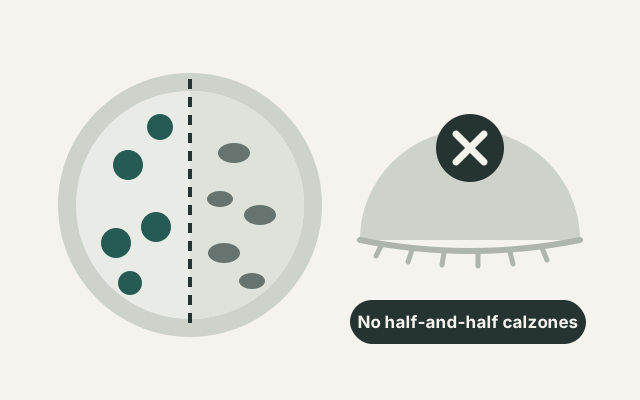
Picture a Friday night. Someone at the counter asks for a calzone, half pepperoni and half mushroom. The person at the register taps the screen, frowns and says the six words everyone in my line of work has caused at least once: "Sorry, the system won't let me."
The customer thinks the system is being stupid. The system is being very smart. Somebody, somewhere, wrote a rule.
The menu is a product model
A pizza menu looks like a list. It is really a set of attributes and options: size, crust, sauce, cheese, toppings, and whether the toppings cover the whole pie or half of it. Multiply them out and a small shop sells thousands of different pizzas without ever writing most of them down.
Some of those combinations make no sense. A calzone is folded in half before it bakes. "Half and half" on a calzone means one end of the fold is pepperoni and the other is mushroom, and the kitchen has no reliable way to make that, or to tell which end is which when it comes out. So the rule is simple: if the product is a calzone, half-and-half toppings are not available. That is a compatibility constraint, and it is doing exactly what it should.
A good rule feels annoying at the counter and invisible in the kitchen. A missing rule feels great at the counter and ruins the kitchen.
Every order becomes a recipe
Once the order is valid, the screen does something you never see. It turns your choices into a list of ingredients and quantities: one 14-inch dough ball, a ladle of sauce, a measured handful of cheese, eighteen slices of pepperoni. In manufacturing we call that a bill of materials. The shop's full list of every ingredient any pizza could need, each with a condition for when it is used, is a 150% BOM. Your pizza's list is the 100% one.
Then comes the routing: stretch, sauce, top, bake for six minutes, cut into eight. A deep dish takes a different oven time. A gluten-free crust goes on its own tray so it never touches flour. The order decides the steps, not just the ingredients.
Monday brings an engineering change
On Monday the cheese supplier changes. The new mozzarella melts differently, so the kitchen will use a little less of it per pizza. That is an engineering change. Easy, until someone asks a sharp question: what about the 40 pizzas a company ordered on Saturday for a Monday lunch?
Do they get the old quantity of the old cheese, or the new quantity of the new cheese? If the old cheese is gone, the Saturday order must change. If it isn't, which bag does the cook reach for? The answer is effectivity: a date from which the new recipe applies, plus a plan for orders already in flight. Get it wrong and nobody notices until a cook is staring at a ticket and two bags of cheese.
Then an order falls out
Now imagine the screen did allow something the kitchen can't make, say a gluten-free crust as a deep dish, because nobody wrote that rule. The order prints, the cook reads it, and it comes straight back to the counter. That bounce is order fallout. One pizza, it's an apology and a free drink. A few hundred configured office chairs for a hospital, and it's a missed delivery date.
The tempting fix is to correct the order and move on. The better fix is to ask why the screen let it through, write the missing rule, and save that exact pizza as a test configuration that gets checked every time the menu changes. I wrote a whole deep dive on that habit.
What the counter is really protecting
Swap the pizza for a commercial door lock and the story barely changes. Functions instead of toppings, finishes instead of sauces, a fire label instead of a gluten-free tray. The rules still exist so that what sales promises, the plant can build, at a price the business can live with. I built a working version of exactly that in the Rules Lab, if you want to try breaking it.
So the next time someone tells you "the system won't let me," be a little kind to the system. Someone like me wrote that rule, almost certainly for a good reason.
Almost certainly.