A composite story. The finish is invented; the pattern is everywhere.
Every portfolio has one. Let's call ours Aubergine.
Aubergine was added years ago for a single hospitality project, a boutique hotel chain that wanted its lobbies to feel “bold but calm.” It was a beautiful finish. The project was a success. The hotel chain was later bought by a company that preferred grey.
Aubergine stayed.
A census
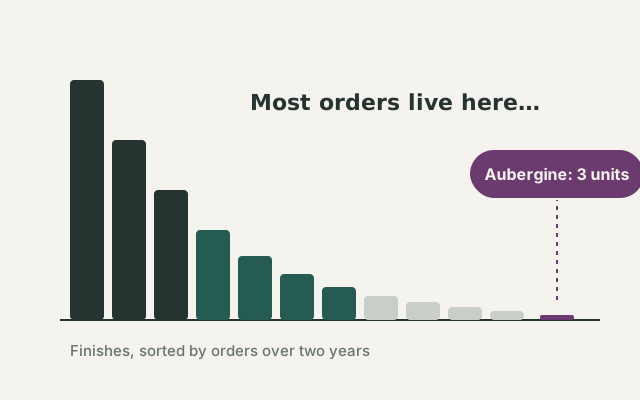
Once a year, someone ought to count. So imagine we do. We take every option in the product line and line it up against two years of orders. The chart looks like every chart of this kind: a few options carry most of the volume, then a long, thin tail stretches off to the right. At the very end of the tail, holding on with one fingernail, is Aubergine. Three units last year. Two the year before. One of those was a sample.
Then we count the other side, the part no chart shows: what it takes to keep Aubergine alive.
- A column in the list price book and in every dealer price file.
- Configuration rules wherever finishes are restricted, plus test configurations that must keep passing.
- Renders and swatches in the dealers' design tools.
- A line on every change impact analysis that touches a painted part.
- A minimum order quantity of paint, slowly expiring on a shelf.
None of these is large. All of them are paid every year, by different teams, none of whom owns the finish.
A zombie variant doesn't cost much anywhere. It costs a little everywhere, and nobody's budget says “Aubergine.”
The defender
Suggest retiring Aubergine and someone will remember a customer. “I think a big account ordered that once.” This is the most important moment in any portfolio review, and the most common way zombies survive. The useful question isn't “did anyone order it?” It's “would anyone leave if it were gone, or would they choose the nearest alternative?”
Almost always, they'd choose the nearest alternative. Often without noticing.
A respectful funeral
Retiring an option isn't deleting a row. Done properly, it's an engineering change: an end date through effectivity so open quotes are honoured, a lifecycle state so it can't be picked again, a plan for the remaining paint, a note for service, and a notice to dealers with a suggested alternative. Then, quietly, the price books get one column shorter.
The term zombie variant comes from Julian Weyer, and it's the most useful phrase I know for this problem, because it names the thing nobody wanted to name.
Why I care about this
In configuration work you see every option from the inside: every rule it needs, every test it adds, every change it touches. That view makes portfolio questions very concrete. “Should we add a fifth finish?” becomes “are we ready to maintain it for ten years?” “Should we keep Aubergine?” becomes “who is paying for it, and do they know?”
The best product lines I've seen aren't the ones with the most choice. They're the ones where every choice is still earning its place. More in the glossary under SKU rationalization and zombie variants.